
Михайлова Татьяна Национальный исследовательский университет «Высшая школа экономики» — Санкт-Петербург, СанктПетербург, Россия
Шлык Полина Национальный исследовательский университет «Высшая школа экономики» — Санкт-Петербург, СанктПетербург, Россия
Грицко Олеся Национальный исследовательский университет «Высшая школа экономики» — Санкт-Петербург, СанктПетербург, Россия
Бордунос Александра Санкт-Петербургский университет, Санкт-Петербург, Россия
Кошелева Софья Санкт-Петербургский университет, Санкт-Петербург, Россия
Зырянова Анна Российская академия народного хозяйства и Государственной службы при Президенте РФ, Москва, Россия
Шлык Полина Национальный исследовательский университет «Высшая школа экономики» — Санкт-Петербург, СанктПетербург, Россия
Грицко Олеся Национальный исследовательский университет «Высшая школа экономики» — Санкт-Петербург, СанктПетербург, Россия
Бордунос Александра Санкт-Петербургский университет, Санкт-Петербург, Россия
Кошелева Софья Санкт-Петербургский университет, Санкт-Петербург, Россия
Зырянова Анна Российская академия народного хозяйства и Государственной службы при Президенте РФ, Москва, Россия
Цель. Исследование ориентировано на повышение гендерной инклюзии в организациях: как работодатели могут поддерживать женщин с обязательствами по уходу за детьми в достижении баланса между рабочими и семейными ролями. Работники с обязательствами по уходу за детьми могут воспринимать влияние семьи на работу как положительное или отрицательное, и такое восприятие сказывается на их благополучии. Опираясь на теорию соответствия человека и окружающей среды, мы предполагаем, что стратегии совладания (coping strategies) могут снизить негативные последствия указанного взаимовлияния и усилить положительные. Дизайн исследования. В опросе приняли участие женщины из стран СНГ с обязательствами по уходу за детьми (N = 200). Данные собирались при тесном партнёрстве с проектом SelfMama.
Результаты. Полученные результаты демонстрируют, что такие стратегии совладания, как позитивное переформулирование и личностный рост, планирование, отрицание и внимательность, при их высокой выраженности действительно делает отрицательную связь между негативным побочным эффектом (spillover effects) семьи на работу и благополучием сотрудника статистически незначимой. В то же время концентрация на эмоциях и их активное выражение, а также поведенческий уход от проблемы действуют схожим образом при низких значениях данных стратегий совладания. Повышение зависимости между положительным побочным эффектом семьи на работу и благополучием наблюдалось при высоких значениях стратегий совладания, связанных с планированием, концентрацией на эмоциях и их активным выражением, отрицанием и внимательностью, и при низких значениях поведенческого ухода от проблемы. Таким образом, наиболее эффективными являются следующие стратегии совладания при их высокой выраженности: планирование, отрицание и внимательность; а также стратегии концентрации на эмоциях и их активное выражение и стратегии поведенческого ухода от проблемы при их низкой выраженности.
Результаты. Полученные результаты демонстрируют, что такие стратегии совладания, как позитивное переформулирование и личностный рост, планирование, отрицание и внимательность, при их высокой выраженности действительно делает отрицательную связь между негативным побочным эффектом (spillover effects) семьи на работу и благополучием сотрудника статистически незначимой. В то же время концентрация на эмоциях и их активное выражение, а также поведенческий уход от проблемы действуют схожим образом при низких значениях данных стратегий совладания. Повышение зависимости между положительным побочным эффектом семьи на работу и благополучием наблюдалось при высоких значениях стратегий совладания, связанных с планированием, концентрацией на эмоциях и их активным выражением, отрицанием и внимательностью, и при низких значениях поведенческого ухода от проблемы. Таким образом, наиболее эффективными являются следующие стратегии совладания при их высокой выраженности: планирование, отрицание и внимательность; а также стратегии концентрации на эмоциях и их активное выражение и стратегии поведенческого ухода от проблемы при их низкой выраженности.
Полную информацию о проведенном исследовании и его результатах вы найдете по ссылке.
Introduction
Gender studies revealed a tendency to consider relationship between family and work as negative, because women have fixed amounts of resources, however, with time positive spillover was also acknowledged, as multiple roles can create enriching experience (Kinnunen et al., 2006). Our research is focused on the impact of family-to-work spillover effect (FTW) on subjective wellbeing of women with childcare commitments in the CIS countries. Subjective well-being refers to how individuals feel about themself (Sirgy et al., 2019).
Companies, which care about employees' well-being and gender inclusion, focus mostly on the work-related factors: how to mitigate negative effects and increase positive effects of work on family (Bordunos et al., 2020; 2021). The opposite spillover direction is more problematic for employers' control due to ethical reasons; thus, employers can affect this issue indirectly, e.g., though boosting needing skills, knowledge, or attitude. In the current study we explore opportunities to build interventions based on developing one group of coping strategies and mitigating the other to empower women dealing with the related problems, which are perceived as moderators in the relationship between spillover-effect and well-being. Theoretical base for the research forms person-environment fit theory (Edwards et al., 1998), which states that the higher the fit between the job-related environment and employees' characteristics, the better is employees' well-being. When women with childcare commitments perceive spillover as positive, they might treat it as evidence of a proper fit, while negative effects might cause their assurance in a misfit, reflecting on their subjective well-being.
Focus on women is motivated by the observation that most frequently, it is working women who face negative consequences of multiple roles, since in addition to their work responsibilities, women tend to take upon themselves most of the responsibilities related to taking care of the house, children, and for many, the older generation (Stephens, Franks, 1999). Alongside their paid activities, women on average spend three times more time than men on unpaid care work (Ferrant et al., 2014). Among adult children who take care of their impaired parents, it is the daughters who most often perform the role of caregiver — three times more likely than adult sons (Stephens, Franks, 1999). This is because in patriarchal communities, women are initially expected to take care of the house while men perform the role of breadwinner (Abubakar, 2018). In addition to the almost mandatory role of caregiver, women took the role of an employee, which could cause conflicts between these domains (Gordon et al., 2011). Such conflicts appeared in women’s life more often than in men’s (Trnka, 2013); and this fact has become decisive in choosing the gender on which this work is focused.
Another reason why the topic remains very crucial these days is the COVID-19. The pandemic changed the course of life all around the world, with the emergence of lockdowns, more people began to switch to remote work, which almost completely erased the border between personal life and work (Bahn et al., 2020). Women have suffered especially badly from this, since they were forced to combine the duties of a parent and an employee for an entire day all week long (Bahn et al., 2020). The pandemic in all its manifestations had such a strong impact on everyone’s lives that many could simply change their approach to certain issues in life, including the area of combining work and family, therefore, findings of studies that were conducted earlier should be revised.
All the factors listed above formed a research gap, which we want to fill by conducting this study and answering the following question: How do coping strategies help women improve relationship between family-to-work spillover and subjective well-being? To do this, we are going to perform a regression analysis on the data collected from February 2021 to February 2022. This questionnaire was distributed with the support of the SelfMama project, which is a CIS-based initiative that helps women combine motherhood and self-realization.
Based on the results of this study, we contribute to the research stream related to gender inclusion by exploring family-to-work spillover and its effect on subjective well-being of women in the CIS countries, and the moderating role of coping strategies. Findings might help to compile or adjust company policies in such a way as to include such training and lifestyle balance initiatives, where women might be taught to independently manage the influence of one domain of their life on another, which could lead to an increase in their subjective well-being.
Companies, which care about employees' well-being and gender inclusion, focus mostly on the work-related factors: how to mitigate negative effects and increase positive effects of work on family (Bordunos et al., 2020; 2021). The opposite spillover direction is more problematic for employers' control due to ethical reasons; thus, employers can affect this issue indirectly, e.g., though boosting needing skills, knowledge, or attitude. In the current study we explore opportunities to build interventions based on developing one group of coping strategies and mitigating the other to empower women dealing with the related problems, which are perceived as moderators in the relationship between spillover-effect and well-being. Theoretical base for the research forms person-environment fit theory (Edwards et al., 1998), which states that the higher the fit between the job-related environment and employees' characteristics, the better is employees' well-being. When women with childcare commitments perceive spillover as positive, they might treat it as evidence of a proper fit, while negative effects might cause their assurance in a misfit, reflecting on their subjective well-being.
Focus on women is motivated by the observation that most frequently, it is working women who face negative consequences of multiple roles, since in addition to their work responsibilities, women tend to take upon themselves most of the responsibilities related to taking care of the house, children, and for many, the older generation (Stephens, Franks, 1999). Alongside their paid activities, women on average spend three times more time than men on unpaid care work (Ferrant et al., 2014). Among adult children who take care of their impaired parents, it is the daughters who most often perform the role of caregiver — three times more likely than adult sons (Stephens, Franks, 1999). This is because in patriarchal communities, women are initially expected to take care of the house while men perform the role of breadwinner (Abubakar, 2018). In addition to the almost mandatory role of caregiver, women took the role of an employee, which could cause conflicts between these domains (Gordon et al., 2011). Such conflicts appeared in women’s life more often than in men’s (Trnka, 2013); and this fact has become decisive in choosing the gender on which this work is focused.
Another reason why the topic remains very crucial these days is the COVID-19. The pandemic changed the course of life all around the world, with the emergence of lockdowns, more people began to switch to remote work, which almost completely erased the border between personal life and work (Bahn et al., 2020). Women have suffered especially badly from this, since they were forced to combine the duties of a parent and an employee for an entire day all week long (Bahn et al., 2020). The pandemic in all its manifestations had such a strong impact on everyone’s lives that many could simply change their approach to certain issues in life, including the area of combining work and family, therefore, findings of studies that were conducted earlier should be revised.
All the factors listed above formed a research gap, which we want to fill by conducting this study and answering the following question: How do coping strategies help women improve relationship between family-to-work spillover and subjective well-being? To do this, we are going to perform a regression analysis on the data collected from February 2021 to February 2022. This questionnaire was distributed with the support of the SelfMama project, which is a CIS-based initiative that helps women combine motherhood and self-realization.
Based on the results of this study, we contribute to the research stream related to gender inclusion by exploring family-to-work spillover and its effect on subjective well-being of women in the CIS countries, and the moderating role of coping strategies. Findings might help to compile or adjust company policies in such a way as to include such training and lifestyle balance initiatives, where women might be taught to independently manage the influence of one domain of their life on another, which could lead to an increase in their subjective well-being.
Theoretical background
The research grounds on the person-environment fit theory (Edwards et al., 1998), which was applied in many studies on stress and subjective well-being (Caplan, Harrison, 1993; Cummings, Cooper, 1979; Edwards, 1992; French et al., 1982; Harrison, 1985). The theory focuses on a degree of individuals' misfit with an environment. It highlights the importance of the subjective perspective on the environment (Harrison, 1978). There are two types of possible misfit. The first type implies the existence of correspondences between certain requirements that arise in the environment and human abilities: skills, time, and the availability of energy to meet certain requirements imposed on a person. The requirements imply expectations from a person to perform certain duties, work requirements, etc. The second type covers human needs, for example, innate biological and psychological needs, and ability of the person to fulfill them in the chosen environment (French, Kahn, 1962; Harrison, 1985). Individuals can improve their fit, for example, by referring to coping strategies.
Subjective well-being
Subjective well-being is defined as a set of human functioning, experiencing positive moments such as contentment, happiness, development of potential, control over one’s life, having goals and positive relationships with people (Huppert, 2009). It is associated with success at the professional, personal, and interpersonal levels, as people with elevated levels of well-being showing greater productivity in the workplace, increased creativity, more effective learning, more prosocial behavior, and positive relationships with others (Diener, 2012; Huppert, So, 2011; Oishi et al., 2009). Subjective well-being in the current study is perceived from an emotional component: how people differ in their level of happiness, treated from the perspective of negative and positive affect (Joshanloo, 2017). There are several scales, which measure these aspects. Among the most widely used ones in CIS countries is Positive and Negative Affect Schedule, PANAS (Osin, 2012; Watson et al, 1988). However, this scale is associated with ongoing debates (Joshanloo, 2017): that it measures not general affect, but positive and negative activation, with a focus on active emotions, moreover its factor structure is still under discussion. The key known alternative is The Negative and Positive Affect Scale, NAPAS (Joshanloo, 2017; Mroczek, Kolarz, 1998), this scale was adopted in the current research. Positive emotions in a certain area of life affect another domain and the feeling of happiness spills over to that area of life, while negative emotions are associated with stress, which also has an impact on the other domain (Sthapit et al., 2020).
Positive family-to-work spillover
The theory of spillover effects states that actions in one domain affect actions in another domain, which person combines (McDaniel et al., 2021). Positive spillover implies that positive aspects in the workplace are capable of enriching life at home and vice versa (Greenhaus, Powell, 2006). It was found that positive effect is likely to arise if there are more resources in any domain, for instance, the possibility of making more autonomous decisions at work, the presence of support from colleagues and managers, and, not least, emotional intimacy with a partner (spouse), which positively affects family relationships (Gzhivach, Marks, 2000).
Prior research confirms that a positive influence between work and family has certain positive outcomes: it leads to job satisfaction, happy marriage, improved mental health and psychological well-being (e.g., Cohn et al., 2009; Gzhivach, Marks, 2000). It is important to note that positive spillover effects can lead to an increase in the effectiveness of performing roles, self-sufficiency, and getting more pleasure from life (Hanson et al., 2006). In addition, it was shown that positive familyto-work (FTW) spillover, namely good relationships with partners and children, prevent, both men and women, from the possibility of mental health complications that could appear due to negative experiences in the workplace (Barnett, 1994). Thus, we put forward the first hypothesis of this paper.
H1: There is a positive relationship between the positive FTW spillover and the subjective wellbeing of women in the CIS countries.
Negative family-to-work spillover
The negative spillover implies limited resources to be able to manage multiple roles in two areas. Any harmful influence between the family and work spheres is associated with the occurrence of negative events in these spheres of life. To this we can attribute a certain transfer of negative attitudes or moods from one area to another (Repetti, Wood, 1997; Williams, Alliger, 1994). A negative FTW spillover influence originates at a time when the demands, time, stress, and effort spent on family responsibilities interfere with the performance of work duties (Netemeyer et al., 1996). That is why this phenomenon is being called negative.
The views and expectations of society placed on career women regarding gender roles vary in different countries, but public opinion might harm not only the career growth of women, but also the atmosphere in the family (Kolpashnikova et al., 2020; O’Neil et al., 2007). An increasing number of working women demonstrates that women are more susceptible to anxiety states, bouts of depression and emotional burnout arising from the perceived experience of "maternal walls", which prevents them from building a career after the birth of a child (Thakur et al., 2018). This statement is also aggravated by the fact that the time spent on household chores takes away the strength and desire to show one’s potential in other areas of life (Lupu et al., 2018). Excessive amount of household chores and increased concentration on performance leads to moral exhaustion and loss of strength, which does not contribute to the high-quality performance of work duties (Valcour, 2007). Based on all of the above, we formulated the second hypothesis of this research.
H2: There is a negative relationship between the negative FTW spillover and the subjective wellbeing of women in the CIS countries.
Coping strategies
The concept of coping — overcoming stress and negative emotions — has been defined as frequently changing human behavior and cognitive efforts that are made to achieve satisfaction of both external and internal needs of an individual. These requirements are usually burdensome, and also involve large internal resources on the part of the person (Lazarus, Folkman, 1984).
In the framework of this study, three different types of coping strategies were analyzed: problemfocused coping, emotion-focused coping and related to mindfulness. Problem-focused coping implies a direct effort to deal with a problem causing a depressed mood (ibid). This type of problem-solving is possible when individuals are confident that they can independently omit problems and a source of stress (ibid). Prior studies showed that if a person has such an ability to omit negative emotions, it brings more optimism into their life, which in turn leads to kindness and compliance (O`Brien, Delongis, 1996; Scheier et al., 1986).
Problem-focused coping
Problem-focused coping consists of three distinct strategies (Carver et al., 1989). Positive reinterpretation and growth imply any attempts aimed at rethinking a negative life event and interpreting it in a positive connotation (for example, searching for the good in the bad, developing the ability to view the problem from a different angle so that it does not seem unsolvable). A concept active coping refers to taking measures in order to eliminate the problem. This type of coping can also include an attempt to mitigate negative consequences. The next type is planning. This is a reflection on how to omit the cause of the problem: following a certain plan of action, thoughts aimed at solving the problem.
Emotion-focused coping
Emotion-focused coping helps to manage the effects of stress (Baker, Berenbaum, 2007; Lazarus, Folkman, 1984). Studies have shown that this type of coping is very useful at times when it is difficult for a person to cope with a stressor (Folkman, Lazarus, 1985; Zakowski et al., 2001). This type of coping likewise includes three different strategies (Carver et al., 1989). Venting of emotion is a way to omit negative thoughts and feelings. Denial implies the belief that there is no problem or source of stress, the person behaves as if the problem is unreal, and everything is fine. Behavioral disengagement happens when an individual makes a minimum of effort or refuses to cope with a problem or a source of stress at all.
oblem or a source of stress at all. The problem-focused coping reduces or eliminates stress (Chao, 2011; Lapierre, Allen, 2006), based on this, we assume that this type of strategy is able to eliminate or mitigate the negative impact of family on work and intensify the positive relationship. In turn, since emotion-focused coping implies an attempt to avoid stress, this type of coping can only further strengthen negative emotions, having no effect over positive relationship.
Mindfulness
Mindfulness means the ability to be aware of emotions, maintain their balance and perceive thoughts and feelings, as well as bodily sensations, through the surrounding environment (Soons et al., 2010). According to G. Feldman et al. (2007), mindfulness has four components.
Awareness
Awareness involves the understanding of factors such as one’s own life experience, bodily sensations, emotional experience, lived daily, thoughts and all external events.
Attention
Attention is the capacity to focus attention on the flow of stimuli that flows inside and outside a person. That is a skill that allows a person to firmly adhere to a certain stream of thoughts, an object of observation and various life goals and objectives, despite the distracting factors.
Present-focus attention
Present-focus is a type of attention focused on external as well as internal factors. That is, the phenomena that occur daily with every minute of consciousness.
Acceptance
Acceptance is a way of living through different things as they are. One does not judge these events as something bad or good, important, or minor. During the occurrence of an anxiety state, such factors as present-focus, attention, awareness, and acceptance help to concentrate, calmly analyze the problem and not to droop (Brown, Ryan, 2003). Emotional outbursts and feelings that cause discomfort are perceived more easily and not as something comprehensive and insoluble, but as a temporary phenomenon that can be treated (Germer, 2009).
Using these techniques, a person, instead of suffering and falling into the abyss of despair and a depressive episode, learns to calmly analyze and make optimal and balanced decisions that can relieve them of the source of stress (Segal et al., 2004). We assume that the application of these approaches while dealing with stress can have a positive effect on subjective well-being, weakening the negative effect.
H3: The relationship between FTW spillover and subjective well-being of women in the CIS countries is moderated by coping strategies in a way that:
H3.1.: problem-focused coping experience a) weakens the effect of negative FTW spillover on subjective well-being and b) intensifies the effect of positive FTW spillover on subjective well-being;
H3.2.: emotion-focused coping experience a) intensifies the effect of negative FTW spillover on subjective well-being and b) has no effect on positive relationship between positive FTW spillover and subjective well-being;
H3.3.: mindfulness a) weakens the effect of negative FTW spillover on subjective well-being and b) intensifies the effect of positive FTW spillover on subjective well-being.
Control variables
Marital status and number of hours a woman spends for childcare commitments were used as control variables.
Prior studies have shown that married people on average rated themselves happier compared to those who did not have a partner (Lyubomirsky et al., 2005). At the same time, other researchers claimed that marriage can be more beneficial for men than for women (Diener et al., 1999). It led to the following hypothesis:
H4: There is positive relationship between marital status and subjective well-being of women in the CIS countries.
Having children in a family can be associated with work-family conflict, family distress and other work-family stressors (Grandey, Cropanzano, 1999), however, there are certain contextual differences (Spector et al., 2004). Our fifth hypothesis:
H5: There is a negative relationship between hours spent on care for children and subjective wellbeing of women in the CIS countries.
The conceptual model
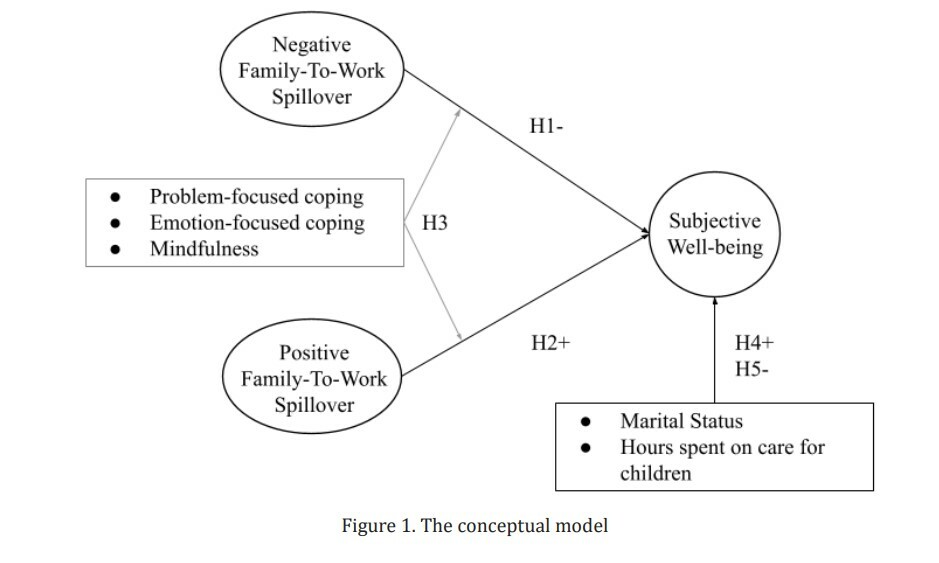
Thus, summarizing the literature review section, we present our conceptual model. In Figure 1, all the concepts that are used in this work can be seen, as well as how they are related to each other.
Subjective well-being
Subjective well-being is defined as a set of human functioning, experiencing positive moments such as contentment, happiness, development of potential, control over one’s life, having goals and positive relationships with people (Huppert, 2009). It is associated with success at the professional, personal, and interpersonal levels, as people with elevated levels of well-being showing greater productivity in the workplace, increased creativity, more effective learning, more prosocial behavior, and positive relationships with others (Diener, 2012; Huppert, So, 2011; Oishi et al., 2009). Subjective well-being in the current study is perceived from an emotional component: how people differ in their level of happiness, treated from the perspective of negative and positive affect (Joshanloo, 2017). There are several scales, which measure these aspects. Among the most widely used ones in CIS countries is Positive and Negative Affect Schedule, PANAS (Osin, 2012; Watson et al, 1988). However, this scale is associated with ongoing debates (Joshanloo, 2017): that it measures not general affect, but positive and negative activation, with a focus on active emotions, moreover its factor structure is still under discussion. The key known alternative is The Negative and Positive Affect Scale, NAPAS (Joshanloo, 2017; Mroczek, Kolarz, 1998), this scale was adopted in the current research. Positive emotions in a certain area of life affect another domain and the feeling of happiness spills over to that area of life, while negative emotions are associated with stress, which also has an impact on the other domain (Sthapit et al., 2020).
Positive family-to-work spillover
The theory of spillover effects states that actions in one domain affect actions in another domain, which person combines (McDaniel et al., 2021). Positive spillover implies that positive aspects in the workplace are capable of enriching life at home and vice versa (Greenhaus, Powell, 2006). It was found that positive effect is likely to arise if there are more resources in any domain, for instance, the possibility of making more autonomous decisions at work, the presence of support from colleagues and managers, and, not least, emotional intimacy with a partner (spouse), which positively affects family relationships (Gzhivach, Marks, 2000).
Prior research confirms that a positive influence between work and family has certain positive outcomes: it leads to job satisfaction, happy marriage, improved mental health and psychological well-being (e.g., Cohn et al., 2009; Gzhivach, Marks, 2000). It is important to note that positive spillover effects can lead to an increase in the effectiveness of performing roles, self-sufficiency, and getting more pleasure from life (Hanson et al., 2006). In addition, it was shown that positive familyto-work (FTW) spillover, namely good relationships with partners and children, prevent, both men and women, from the possibility of mental health complications that could appear due to negative experiences in the workplace (Barnett, 1994). Thus, we put forward the first hypothesis of this paper.
H1: There is a positive relationship between the positive FTW spillover and the subjective wellbeing of women in the CIS countries.
Negative family-to-work spillover
The negative spillover implies limited resources to be able to manage multiple roles in two areas. Any harmful influence between the family and work spheres is associated with the occurrence of negative events in these spheres of life. To this we can attribute a certain transfer of negative attitudes or moods from one area to another (Repetti, Wood, 1997; Williams, Alliger, 1994). A negative FTW spillover influence originates at a time when the demands, time, stress, and effort spent on family responsibilities interfere with the performance of work duties (Netemeyer et al., 1996). That is why this phenomenon is being called negative.
The views and expectations of society placed on career women regarding gender roles vary in different countries, but public opinion might harm not only the career growth of women, but also the atmosphere in the family (Kolpashnikova et al., 2020; O’Neil et al., 2007). An increasing number of working women demonstrates that women are more susceptible to anxiety states, bouts of depression and emotional burnout arising from the perceived experience of "maternal walls", which prevents them from building a career after the birth of a child (Thakur et al., 2018). This statement is also aggravated by the fact that the time spent on household chores takes away the strength and desire to show one’s potential in other areas of life (Lupu et al., 2018). Excessive amount of household chores and increased concentration on performance leads to moral exhaustion and loss of strength, which does not contribute to the high-quality performance of work duties (Valcour, 2007). Based on all of the above, we formulated the second hypothesis of this research.
H2: There is a negative relationship between the negative FTW spillover and the subjective wellbeing of women in the CIS countries.
Coping strategies
The concept of coping — overcoming stress and negative emotions — has been defined as frequently changing human behavior and cognitive efforts that are made to achieve satisfaction of both external and internal needs of an individual. These requirements are usually burdensome, and also involve large internal resources on the part of the person (Lazarus, Folkman, 1984).
In the framework of this study, three different types of coping strategies were analyzed: problemfocused coping, emotion-focused coping and related to mindfulness. Problem-focused coping implies a direct effort to deal with a problem causing a depressed mood (ibid). This type of problem-solving is possible when individuals are confident that they can independently omit problems and a source of stress (ibid). Prior studies showed that if a person has such an ability to omit negative emotions, it brings more optimism into their life, which in turn leads to kindness and compliance (O`Brien, Delongis, 1996; Scheier et al., 1986).
Problem-focused coping
Problem-focused coping consists of three distinct strategies (Carver et al., 1989). Positive reinterpretation and growth imply any attempts aimed at rethinking a negative life event and interpreting it in a positive connotation (for example, searching for the good in the bad, developing the ability to view the problem from a different angle so that it does not seem unsolvable). A concept active coping refers to taking measures in order to eliminate the problem. This type of coping can also include an attempt to mitigate negative consequences. The next type is planning. This is a reflection on how to omit the cause of the problem: following a certain plan of action, thoughts aimed at solving the problem.
Emotion-focused coping
Emotion-focused coping helps to manage the effects of stress (Baker, Berenbaum, 2007; Lazarus, Folkman, 1984). Studies have shown that this type of coping is very useful at times when it is difficult for a person to cope with a stressor (Folkman, Lazarus, 1985; Zakowski et al., 2001). This type of coping likewise includes three different strategies (Carver et al., 1989). Venting of emotion is a way to omit negative thoughts and feelings. Denial implies the belief that there is no problem or source of stress, the person behaves as if the problem is unreal, and everything is fine. Behavioral disengagement happens when an individual makes a minimum of effort or refuses to cope with a problem or a source of stress at all.
oblem or a source of stress at all. The problem-focused coping reduces or eliminates stress (Chao, 2011; Lapierre, Allen, 2006), based on this, we assume that this type of strategy is able to eliminate or mitigate the negative impact of family on work and intensify the positive relationship. In turn, since emotion-focused coping implies an attempt to avoid stress, this type of coping can only further strengthen negative emotions, having no effect over positive relationship.
Mindfulness
Mindfulness means the ability to be aware of emotions, maintain their balance and perceive thoughts and feelings, as well as bodily sensations, through the surrounding environment (Soons et al., 2010). According to G. Feldman et al. (2007), mindfulness has four components.
Awareness
Awareness involves the understanding of factors such as one’s own life experience, bodily sensations, emotional experience, lived daily, thoughts and all external events.
Attention
Attention is the capacity to focus attention on the flow of stimuli that flows inside and outside a person. That is a skill that allows a person to firmly adhere to a certain stream of thoughts, an object of observation and various life goals and objectives, despite the distracting factors.
Present-focus attention
Present-focus is a type of attention focused on external as well as internal factors. That is, the phenomena that occur daily with every minute of consciousness.
Acceptance
Acceptance is a way of living through different things as they are. One does not judge these events as something bad or good, important, or minor. During the occurrence of an anxiety state, such factors as present-focus, attention, awareness, and acceptance help to concentrate, calmly analyze the problem and not to droop (Brown, Ryan, 2003). Emotional outbursts and feelings that cause discomfort are perceived more easily and not as something comprehensive and insoluble, but as a temporary phenomenon that can be treated (Germer, 2009).
Using these techniques, a person, instead of suffering and falling into the abyss of despair and a depressive episode, learns to calmly analyze and make optimal and balanced decisions that can relieve them of the source of stress (Segal et al., 2004). We assume that the application of these approaches while dealing with stress can have a positive effect on subjective well-being, weakening the negative effect.
H3: The relationship between FTW spillover and subjective well-being of women in the CIS countries is moderated by coping strategies in a way that:
H3.1.: problem-focused coping experience a) weakens the effect of negative FTW spillover on subjective well-being and b) intensifies the effect of positive FTW spillover on subjective well-being;
H3.2.: emotion-focused coping experience a) intensifies the effect of negative FTW spillover on subjective well-being and b) has no effect on positive relationship between positive FTW spillover and subjective well-being;
H3.3.: mindfulness a) weakens the effect of negative FTW spillover on subjective well-being and b) intensifies the effect of positive FTW spillover on subjective well-being.
Control variables
Marital status and number of hours a woman spends for childcare commitments were used as control variables.
Prior studies have shown that married people on average rated themselves happier compared to those who did not have a partner (Lyubomirsky et al., 2005). At the same time, other researchers claimed that marriage can be more beneficial for men than for women (Diener et al., 1999). It led to the following hypothesis:
H4: There is positive relationship between marital status and subjective well-being of women in the CIS countries.
Having children in a family can be associated with work-family conflict, family distress and other work-family stressors (Grandey, Cropanzano, 1999), however, there are certain contextual differences (Spector et al., 2004). Our fifth hypothesis:
H5: There is a negative relationship between hours spent on care for children and subjective wellbeing of women in the CIS countries.
The conceptual model
Thus, summarizing the literature review section, we present our conceptual model. In Figure 1, all the concepts that are used in this work can be seen, as well as how they are related to each other.
Methods and data
Sample structure
Table 1 represents information about the sample. We received 213 responses, however, after cleaning the data and filtering in accordance with the objectives of the study, the number of observations were reduced to 200 women from 19 to 54 years old living in Russia (172), Belarus (12) and other countries. The missing values were replaced by the median value for this variable.
Table 1 represents information about the sample. We received 213 responses, however, after cleaning the data and filtering in accordance with the objectives of the study, the number of observations were reduced to 200 women from 19 to 54 years old living in Russia (172), Belarus (12) and other countries. The missing values were replaced by the median value for this variable.

Measures
The data for the analysis was obtained through an online questionnaire distributed using Google Forms. Such an approach is associated with several common method biases, such as common rater effects, item characteristic effects, item context effects and measurement context effects. However, to control them, the recommendations given by P. M. Podsakoff with colleagues have been resorted to (Podsakoff et al., 2003). First, the design of the questionnaire was carefully developed: the necessary measures were adopted after their prior validation in trustworthy sources. All questions were translated from English into Russian, in consultation with a qualified interpreter. The questionnaire was divided into semantic parts; and, various types of response formats were used (Likert scales, close- and openended questions). The questionnaire consisted of several sections. Before we could start performing a regression analysis, we checked reliability and validity of the measures that are used in this research with four requirements (Wetzel, 2011): criterion validity (Grzywacz, Marks, 2000; Joshanloo, 2017; Mroczek, Kolarz, 1998); face validity, construct validity, discriminant validity for the selected sample (Tables 2−4). For this purpose, we conducted Exploratory Factor Analysis (EFA), referring to a principal component analysis with the help of orthogonal varimax rotation of loading matrix.
The data for the analysis was obtained through an online questionnaire distributed using Google Forms. Such an approach is associated with several common method biases, such as common rater effects, item characteristic effects, item context effects and measurement context effects. However, to control them, the recommendations given by P. M. Podsakoff with colleagues have been resorted to (Podsakoff et al., 2003). First, the design of the questionnaire was carefully developed: the necessary measures were adopted after their prior validation in trustworthy sources. All questions were translated from English into Russian, in consultation with a qualified interpreter. The questionnaire was divided into semantic parts; and, various types of response formats were used (Likert scales, close- and openended questions). The questionnaire consisted of several sections. Before we could start performing a regression analysis, we checked reliability and validity of the measures that are used in this research with four requirements (Wetzel, 2011): criterion validity (Grzywacz, Marks, 2000; Joshanloo, 2017; Mroczek, Kolarz, 1998); face validity, construct validity, discriminant validity for the selected sample (Tables 2−4). For this purpose, we conducted Exploratory Factor Analysis (EFA), referring to a principal component analysis with the help of orthogonal varimax rotation of loading matrix.
Subjective well-being
We measured subjective well-being with the NAPAS scale, meaning "negative and positive affect scale" (Joshanloo, 2017; Mroczek, Kolarz, 1998). It is a twelve-item scale that measures six negative and another six positive emotional states that person recently experienced. It was captured with a frequency scale varying from "always" to "never." During analysis negative statements were reversed coded. The reliability of this scale has been evaluated on numerous examples in past studies (e.g., Chan et al., 2020).
We measured subjective well-being with the NAPAS scale, meaning "negative and positive affect scale" (Joshanloo, 2017; Mroczek, Kolarz, 1998). It is a twelve-item scale that measures six negative and another six positive emotional states that person recently experienced. It was captured with a frequency scale varying from "always" to "never." During analysis negative statements were reversed coded. The reliability of this scale has been evaluated on numerous examples in past studies (e.g., Chan et al., 2020).
Family-to-work spillover
We referred to a scale of J. G. Grzywacz and N. F. Marks, which treats FTW spillover as two separate dimensions, consisting of four items each (Grzywacz, Marks, 2000). Respondents could rate these items on a scale from 5 ("absolutely right") to 1 ("absolutely wrong"). It is worth noting that one of the items measuring PFW is reverse coded, due to the way it is formulated, namely "Providing for what is needed at home makes work harder at job", so during analysis firstly it was reverse coded.
We referred to a scale of J. G. Grzywacz and N. F. Marks, which treats FTW spillover as two separate dimensions, consisting of four items each (Grzywacz, Marks, 2000). Respondents could rate these items on a scale from 5 ("absolutely right") to 1 ("absolutely wrong"). It is worth noting that one of the items measuring PFW is reverse coded, due to the way it is formulated, namely "Providing for what is needed at home makes work harder at job", so during analysis firstly it was reverse coded.
Coping strategies and mindfulness
The problem-focused coping and emotion-focused coping are measured in three dimensions each, relying on the COPE scale (Carver et al., 1989). We have used each of these six dimensions as a Organizational Psychology, 2023, Vol. 13, No. 2. www.orgpsyjournal.hse.ru 181 separate coping strategy. For problem-focused coping those dimensions are the following: positive reinterpretation and growth, active coping, and planning; for emotion-focused coping: venting of emotions, denial, and behavioral disengagement. Each of these dimensions were measured using four items on a scale from "always" (5) to "never" (1).
The scale for measurement of mindfulness — Cognitive and Affective Mindfulness Scale-Revised (CAMS-R) — was first described in an article by G. Feldman with colleagues (2007). This is a 12-item scale that ranges from "always" (5) to "never" (1); items 2, 6, and 7 are reverse coded. Further, this scale can be divided into four separate strategies: attention, present focus, awareness, and acceptance.
The problem-focused coping and emotion-focused coping are measured in three dimensions each, relying on the COPE scale (Carver et al., 1989). We have used each of these six dimensions as a Organizational Psychology, 2023, Vol. 13, No. 2. www.orgpsyjournal.hse.ru 181 separate coping strategy. For problem-focused coping those dimensions are the following: positive reinterpretation and growth, active coping, and planning; for emotion-focused coping: venting of emotions, denial, and behavioral disengagement. Each of these dimensions were measured using four items on a scale from "always" (5) to "never" (1).
The scale for measurement of mindfulness — Cognitive and Affective Mindfulness Scale-Revised (CAMS-R) — was first described in an article by G. Feldman with colleagues (2007). This is a 12-item scale that ranges from "always" (5) to "never" (1); items 2, 6, and 7 are reverse coded. Further, this scale can be divided into four separate strategies: attention, present focus, awareness, and acceptance.
Methods
To answer the research question of this study, a data analysis method such as moderated regression was used. For analyzing the role of coping strategies, two different sub-samples for each coping strategy are prepared: one containing a high level of a coping strategy, according to median, and second sub-sample with a low level of it. The data was cleaned in Microsoft Excel and analyzed in statistical software — STATA version 17.
We started with a correlation analysis of all variables to find out how strong the relationship between them is. The results are presented in Table 5. Subsequently, the quality of the model was assessed with a number of tests, such as graphical visualization (scatter and histograms), VIF and Breusch — Pagan tests, which are described in more detail in the next section. In regression analysis we referred to standardized Beta coefficients.
To answer the research question of this study, a data analysis method such as moderated regression was used. For analyzing the role of coping strategies, two different sub-samples for each coping strategy are prepared: one containing a high level of a coping strategy, according to median, and second sub-sample with a low level of it. The data was cleaned in Microsoft Excel and analyzed in statistical software — STATA version 17.
We started with a correlation analysis of all variables to find out how strong the relationship between them is. The results are presented in Table 5. Subsequently, the quality of the model was assessed with a number of tests, such as graphical visualization (scatter and histograms), VIF and Breusch — Pagan tests, which are described in more detail in the next section. In regression analysis we referred to standardized Beta coefficients.
Results and findings
Exploratory factor analysis
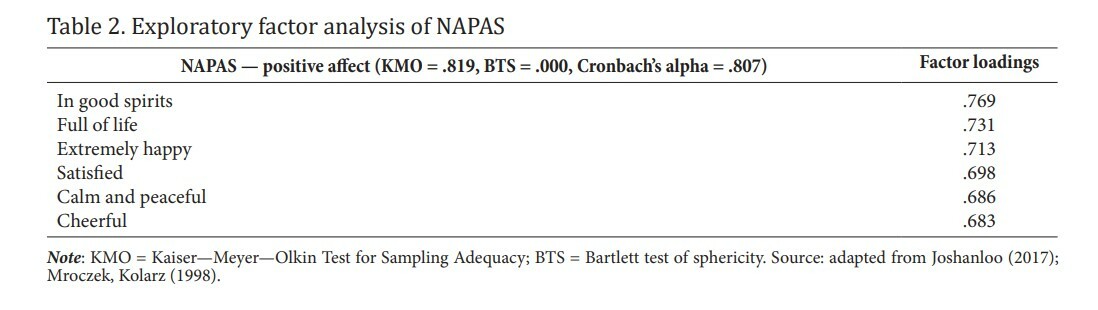
We started the data analysis with assessing reliability and validity of these scales for our sample by conducting EFA. Regarding the NAPAS scale, EFA led to reduction of negative affect items. For the regression analysis itself, we took a mean of all positive affect items (Table 2).
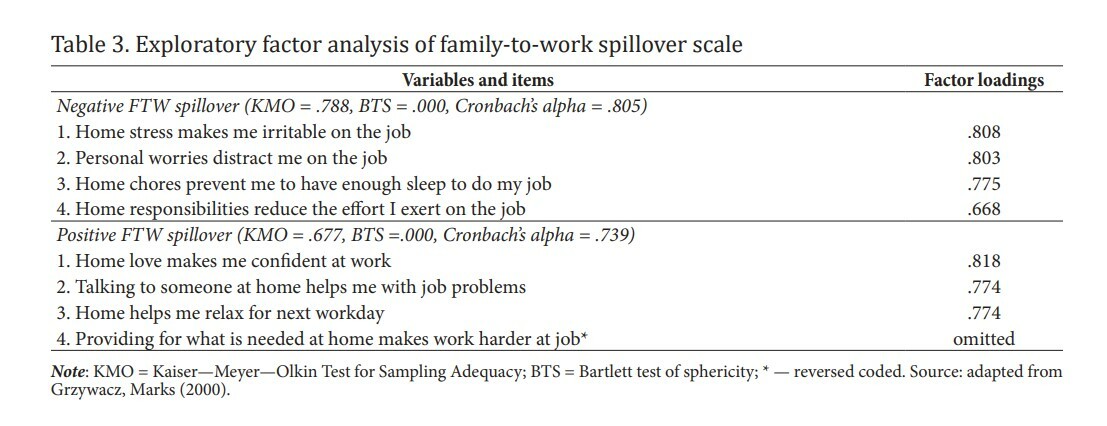
As a result of the EFA of family-to-work spillover, a two-factor structure was confirmed. As Table 3 shows, the first factor has the loadings of all items exceeding 0.4, and the value of Cronbach’s alpha is 0.805, therefore, all four items will be used to calculate the "negative FTW spillover" variable. In the second factor, one of the items has too low loading. Therefore, it was decided to exclude this item from the factor, because of which the value of Cronbach’s alpha increased to 0.739. Accordingly, the "positive FTW spillover" variable was calculated as the mean of these three items. The Cronbach’s alpha exceeds the suggested threshold of 0.7 (Tavakol, Dennick, 2011).
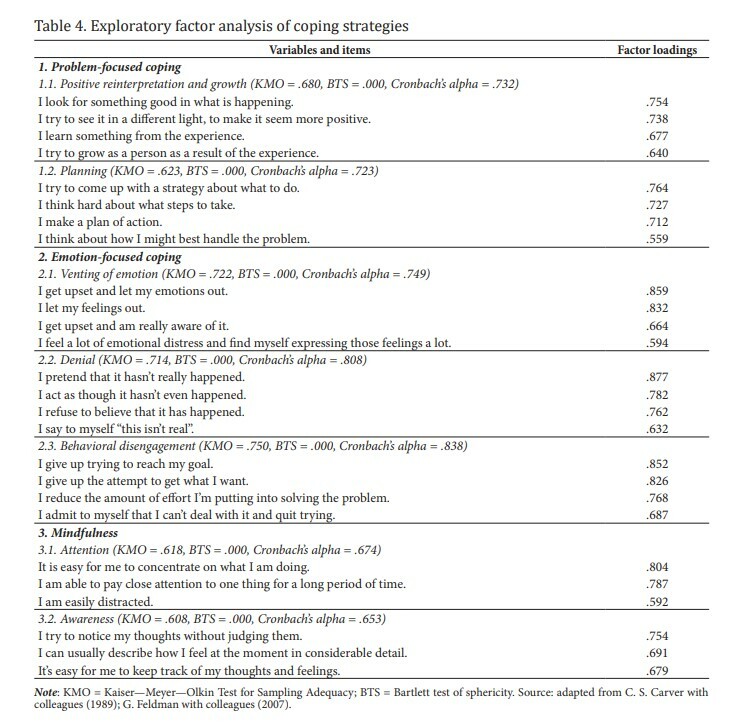
All ten coping strategies (36 items) were used for the EFA. We had to exclude three strategies due to poor factor structure: active coping, present focus, and acceptance. The overall value of the kept coping strategies was calculated as a mean of items related to a particular factor.
We started the data analysis with assessing reliability and validity of these scales for our sample by conducting EFA. Regarding the NAPAS scale, EFA led to reduction of negative affect items. For the regression analysis itself, we took a mean of all positive affect items (Table 2).
As a result of the EFA of family-to-work spillover, a two-factor structure was confirmed. As Table 3 shows, the first factor has the loadings of all items exceeding 0.4, and the value of Cronbach’s alpha is 0.805, therefore, all four items will be used to calculate the "negative FTW spillover" variable. In the second factor, one of the items has too low loading. Therefore, it was decided to exclude this item from the factor, because of which the value of Cronbach’s alpha increased to 0.739. Accordingly, the "positive FTW spillover" variable was calculated as the mean of these three items. The Cronbach’s alpha exceeds the suggested threshold of 0.7 (Tavakol, Dennick, 2011).
All ten coping strategies (36 items) were used for the EFA. We had to exclude three strategies due to poor factor structure: active coping, present focus, and acceptance. The overall value of the kept coping strategies was calculated as a mean of items related to a particular factor.
Hypothesis testing
The descriptive statistics of all analyzed variables are presented in Tables 5. Correlation matrix shows that all independent variables (negative and positive FTW spillover) have significant relation with the dependent variable (subjective well-being). As for moderators, we can see that 3 out of 7 coping strategies (planning, venting of emotions, denial) have weak correlation with the dependent variable. It also shows a satisfying level of correlation between all independent variables with the highest value -0.456 (p < 0.01) between negative and positive FTW spillover.
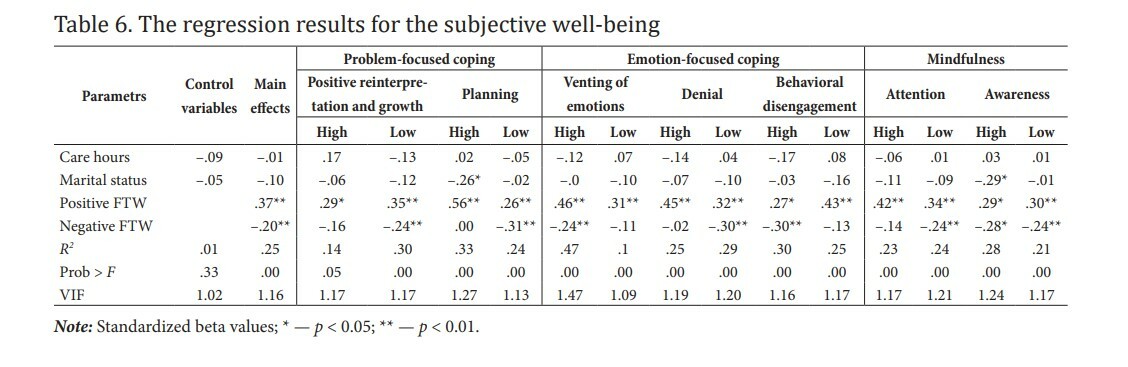
The first two hypotheses were tested on the whole sample (N = 200). The first hypothesis stating that there is a positive relationship between the positive FTW spillover and the subjective well-being of women in the CIS countries, was supported (β = 0.37; p < 0.01). Furthermore, as it can be seen from Table 6, such coping strategies, as planning (β = 0.56; p < 0.01), venting of emotions (β = 0.46; p < 0.01), denial (β = 0.45; p < 0.01) and attention (β = 0.42; p < 0.01), with their high degree of severity, increased the interdependence between the positive spillover effect of the family on work and well-being, while behavioral disengagement affected similarly at low values (β = 0.43; p < 0.01). Such findings partially support our third hypothesis about positive moderating effects of problem-focused coping strategies (H3.1.b) and mindfulness (H3.3.b), while we assumed there is no statistically significant moderating effect of emotion-focused coping strategies (H3.2.b). As it turned out, a high degree of positive reinterpretation and growth (β = 0.29; p < 0.05), as well as awareness (β = 0.29; p < 0.05), led to the opposite effect.
According to our second hypothesis, there is a negative relationship between the negative FTW spillover and the subjective well-being of women in the CIS countries. It was supported (β = -0.20; p < 0.01). At the same time, coping strategies for positive reinterpretation and growth (β = -0.16; p > 0.05), planning (β = 0.00; p > 0.05), denial (β = -0.02; p > 0.05), and attention (β = -0.14; p > 0.05) with their high degree of severity, eliminated the negative relationship between the negative FTW spillover and the well-being of employees, meanwhile venting of emotions and behavioral disengagement acted similarly at low values.
Such findings partially support our third hypothesis about the negative moderating effect of problem-focused coping strategies (H3.1.a) and mindfulness (H3.3.a), while the effect of emotionfocused coping strategies was expected to act in a positive way (H3.2.a). The regression revealed that high degree of awareness, on the contrary, intensified the relationship between negative FTW spillover and subjective well-being in a negative way. It was also unexpected that emotion-focused coping strategies, such as venting of emotions and denial, helped women to eliminate the harming effect of negative FTW spillover on subjective well-being.
The descriptive statistics of all analyzed variables are presented in Tables 5. Correlation matrix shows that all independent variables (negative and positive FTW spillover) have significant relation with the dependent variable (subjective well-being). As for moderators, we can see that 3 out of 7 coping strategies (planning, venting of emotions, denial) have weak correlation with the dependent variable. It also shows a satisfying level of correlation between all independent variables with the highest value -0.456 (p < 0.01) between negative and positive FTW spillover.
The first two hypotheses were tested on the whole sample (N = 200). The first hypothesis stating that there is a positive relationship between the positive FTW spillover and the subjective well-being of women in the CIS countries, was supported (β = 0.37; p < 0.01). Furthermore, as it can be seen from Table 6, such coping strategies, as planning (β = 0.56; p < 0.01), venting of emotions (β = 0.46; p < 0.01), denial (β = 0.45; p < 0.01) and attention (β = 0.42; p < 0.01), with their high degree of severity, increased the interdependence between the positive spillover effect of the family on work and well-being, while behavioral disengagement affected similarly at low values (β = 0.43; p < 0.01). Such findings partially support our third hypothesis about positive moderating effects of problem-focused coping strategies (H3.1.b) and mindfulness (H3.3.b), while we assumed there is no statistically significant moderating effect of emotion-focused coping strategies (H3.2.b). As it turned out, a high degree of positive reinterpretation and growth (β = 0.29; p < 0.05), as well as awareness (β = 0.29; p < 0.05), led to the opposite effect.
According to our second hypothesis, there is a negative relationship between the negative FTW spillover and the subjective well-being of women in the CIS countries. It was supported (β = -0.20; p < 0.01). At the same time, coping strategies for positive reinterpretation and growth (β = -0.16; p > 0.05), planning (β = 0.00; p > 0.05), denial (β = -0.02; p > 0.05), and attention (β = -0.14; p > 0.05) with their high degree of severity, eliminated the negative relationship between the negative FTW spillover and the well-being of employees, meanwhile venting of emotions and behavioral disengagement acted similarly at low values.
Such findings partially support our third hypothesis about the negative moderating effect of problem-focused coping strategies (H3.1.a) and mindfulness (H3.3.a), while the effect of emotionfocused coping strategies was expected to act in a positive way (H3.2.a). The regression revealed that high degree of awareness, on the contrary, intensified the relationship between negative FTW spillover and subjective well-being in a negative way. It was also unexpected that emotion-focused coping strategies, such as venting of emotions and denial, helped women to eliminate the harming effect of negative FTW spillover on subjective well-being.
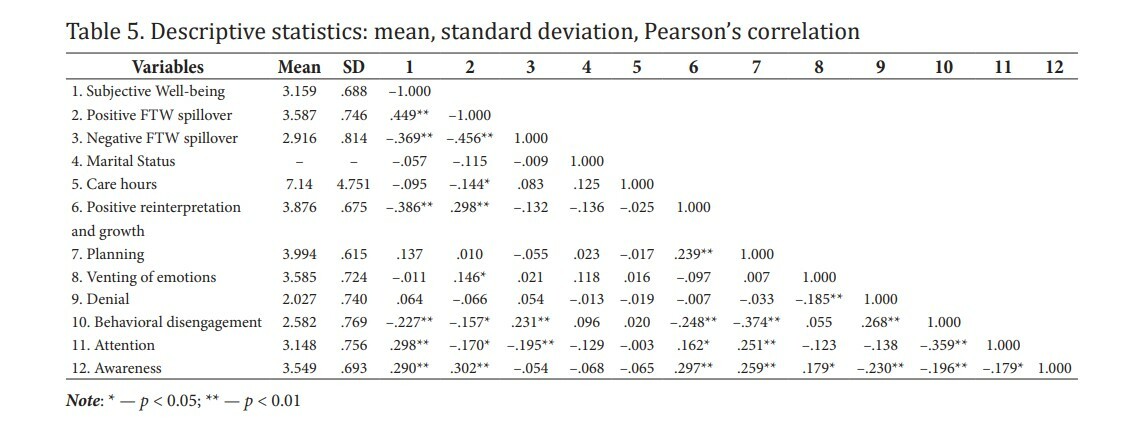
The fourth hypothesis is that there is a positive relationship between marital status and subjective well-being of women in the CIS countries could not be supported, as the relationship was statistically insignificant (β = -0.10; p > 0.05). At the same time, the correlation between "subjective well-being" and "marital status" was weakly negative (-5.7%).
Our fifth hypothesis states that there is a negative relationship between hours spent on care for children and subjective well-being of women in the CIS countries. As it can be seen from Table 6, the variable "hours spent on care for children" is not statistically significant (β = -0.01; p > 0.05), hence H4 is not supported. In addition, according to correlation analysis (Table 5), the ratio between "subjective well-being" and "hours spent on care for children" is weakly negative (-9.5%), showing more similarity with Asian culture, than with Anglo-Saxon (Spector et al., 2004).
Our fifth hypothesis states that there is a negative relationship between hours spent on care for children and subjective well-being of women in the CIS countries. As it can be seen from Table 6, the variable "hours spent on care for children" is not statistically significant (β = -0.01; p > 0.05), hence H4 is not supported. In addition, according to correlation analysis (Table 5), the ratio between "subjective well-being" and "hours spent on care for children" is weakly negative (-9.5%), showing more similarity with Asian culture, than with Anglo-Saxon (Spector et al., 2004).
Discussion
The main task for conducting research was to find a topic that was interesting to us and would have a potential to contribute to the niche that is a burning issue in today’s society. We sincerely believe that the topic we have been working on not only deserves to grow in popularity and discussion in the media but will also bring something new for women from CIS countries. It is worth noting that due to the importance of this agenda, namely the search for ways to enhance women’s subjective well-being, as well as constant conversations in the mass media about the problems faced by women due to the lack of balance between work and family in their lives, such studies have been conducted more and more (Aazami et al., 2015). The main study group of our study consisted of women. Women have become the primary target of these articles for many reasons: discrimination they face not only in society but also in the workplace in terms of salaries, career progression, and leadership positions. In turn, such a career advancement is also complicated by the fact that there is a stigma regarding which of the partners performs household duties. As a rule, women are expected to perform several duties after a hard-working day (Poduval, Poduval, 2009). Namely: washing, cooking, cleaning, classes with a child, caring for elderly relatives and so on. If all the responsibilities of this kind fall entirely on a woman, this may lead to emotional burnout and other mental issues (Maslach, Leiter, 2016). It becomes almost impossible for women to perform their work duties after such demanding work at home, which only strengthens the stereotypes about female employees and hinders their careers (Lazarus, Folkman, 1984). It is to reduce such stereotypes that we decided to study this topic in detail and devote this work to it.
The topicality of the raised problems is proofed by the existing strategy "National Action Strategy for Women 2023−2030" (№ 4356-р, 2022) implemented by the Government of Russian Federation Organizational Psychology, 2023, Vol. 13, No. 2. www.orgpsyjournal.hse.ru 185 (Government…, 2022). On the one hand, it claims a high necessity of active implementation by the companies of the programs to support working women with children, women’s career advancement. On the other hand, it calls for creation of conditions for the preservation of traditional family values and achieving a balance between commitment in private life and in the business sphere in order to improve the quality of life of women. At first it could seem a contradictory statement, however, perspective from spillover effect mitigates seeming contradiction.
With the help of a regression model, we proved that in CIS enrichment received at home has a positive effect on the woman’s work, then her well-being improves. These outputs are consistent with past research (e.g., Alexander, Wood, 2000; Chawla, Sharma, 2019). Negative emotions experienced at home have a direct detrimental effect on women and their subjective well-being. This is also similar to the results of past research in this area (e.g., Das et al., 2020; Luhmann et al., 2012; McRae et al., 2008).
The interesting findings revealed the third hypothesis, allowing us to select the most effective ways to improve the well-being of women. A total of five coping strategies, out of seven initially analyzed, successfully moderate the impact of family-to-work spillover. Such strategies as planning, denial and attention are the most effective with high severity, while venting of emotions and behavioral disengagement acted counterproductively. Hence, we recommend women to apply the revealed successful strategies for improvement of subjective well-being.
The analysis of the relationship between family and work plays a significant role in our study. Women enjoy a sense of financial security and independence that their workplace provides them (Huber et al., 2009). Such a positive impact on the subjective well-being of women’s mental health comes from all the advantages that arise from employment. The most obvious are status, power, and a financial cushion. We also suggested that such a positive effect is enhanced due to the fact that the availability of employment and the status that is provided by the workplace increases women’s selfesteem. It is also important to note our observation regarding how the employment of women can be one of the potential guarantors of equal relations in marriage (Dubler, 2003). In numerous studies focused on the subjective well-being of women, as well as working women, the topic is raised that work and financial remuneration for it, play a big role for the mental health of working women (Lips, 2016; Seedat, Rondon, 2021). In turn, when a woman is sitting at home and constantly performing the duties of a housewife, this is considered one of the main factors of the negative state and deteriorated mental health among unemployed women. The presence of a workplace, in this theory, is the main factor that mitigates all those frustrations and negativity caused in the family and marriage. We also suggested that this might be especially relevant when it comes to career advancement. We believe that the expectation of promotion and the impatience associated with it stems from the desire to gain status, recognition in society and power.
Furthermore, we also managed to find out the fact that family status, within the framework of our study, does not impact well-being in any way. In this case, we are talking about the presence or absence of a partner in a woman’s life (Zirima, 2020). Unlike the first two hypotheses, this is where the geographical component comes into play, given the fact that women, who participated in the survey, have a common background of the CIS countries and the mentality of the former USSR countries. We suggest that historically CIS countries quite often experienced political, economic, and demographic crises, during which women often had to stay alone and carry the household on their shoulders. This is what brought up women to be independent, no matter what (Foster, 2011), while having a partner often might lead to an increase of the load in the "second shift".
In results of testing the fifth hypothesis we were able to find out that there is no statistically significant relationship between hours spent for taking care of children and wellbeing of women in CIS countries. This may be because this aspect is highly contextual (Spector et al., 2004), while we analyze too large territory with diverse cultural beliefs on it.
The topicality of the raised problems is proofed by the existing strategy "National Action Strategy for Women 2023−2030" (№ 4356-р, 2022) implemented by the Government of Russian Federation Organizational Psychology, 2023, Vol. 13, No. 2. www.orgpsyjournal.hse.ru 185 (Government…, 2022). On the one hand, it claims a high necessity of active implementation by the companies of the programs to support working women with children, women’s career advancement. On the other hand, it calls for creation of conditions for the preservation of traditional family values and achieving a balance between commitment in private life and in the business sphere in order to improve the quality of life of women. At first it could seem a contradictory statement, however, perspective from spillover effect mitigates seeming contradiction.
With the help of a regression model, we proved that in CIS enrichment received at home has a positive effect on the woman’s work, then her well-being improves. These outputs are consistent with past research (e.g., Alexander, Wood, 2000; Chawla, Sharma, 2019). Negative emotions experienced at home have a direct detrimental effect on women and their subjective well-being. This is also similar to the results of past research in this area (e.g., Das et al., 2020; Luhmann et al., 2012; McRae et al., 2008).
The interesting findings revealed the third hypothesis, allowing us to select the most effective ways to improve the well-being of women. A total of five coping strategies, out of seven initially analyzed, successfully moderate the impact of family-to-work spillover. Such strategies as planning, denial and attention are the most effective with high severity, while venting of emotions and behavioral disengagement acted counterproductively. Hence, we recommend women to apply the revealed successful strategies for improvement of subjective well-being.
The analysis of the relationship between family and work plays a significant role in our study. Women enjoy a sense of financial security and independence that their workplace provides them (Huber et al., 2009). Such a positive impact on the subjective well-being of women’s mental health comes from all the advantages that arise from employment. The most obvious are status, power, and a financial cushion. We also suggested that such a positive effect is enhanced due to the fact that the availability of employment and the status that is provided by the workplace increases women’s selfesteem. It is also important to note our observation regarding how the employment of women can be one of the potential guarantors of equal relations in marriage (Dubler, 2003). In numerous studies focused on the subjective well-being of women, as well as working women, the topic is raised that work and financial remuneration for it, play a big role for the mental health of working women (Lips, 2016; Seedat, Rondon, 2021). In turn, when a woman is sitting at home and constantly performing the duties of a housewife, this is considered one of the main factors of the negative state and deteriorated mental health among unemployed women. The presence of a workplace, in this theory, is the main factor that mitigates all those frustrations and negativity caused in the family and marriage. We also suggested that this might be especially relevant when it comes to career advancement. We believe that the expectation of promotion and the impatience associated with it stems from the desire to gain status, recognition in society and power.
Furthermore, we also managed to find out the fact that family status, within the framework of our study, does not impact well-being in any way. In this case, we are talking about the presence or absence of a partner in a woman’s life (Zirima, 2020). Unlike the first two hypotheses, this is where the geographical component comes into play, given the fact that women, who participated in the survey, have a common background of the CIS countries and the mentality of the former USSR countries. We suggest that historically CIS countries quite often experienced political, economic, and demographic crises, during which women often had to stay alone and carry the household on their shoulders. This is what brought up women to be independent, no matter what (Foster, 2011), while having a partner often might lead to an increase of the load in the "second shift".
In results of testing the fifth hypothesis we were able to find out that there is no statistically significant relationship between hours spent for taking care of children and wellbeing of women in CIS countries. This may be because this aspect is highly contextual (Spector et al., 2004), while we analyze too large territory with diverse cultural beliefs on it.
Conclusion
The research showed a diverse role of coping strategies in the FTW spillover effects on subjective well-being of women in CIS countries. It contributes to the research stream related to gender inclusion and person-environment fit theory by exploring the specificity of the context. According to the "National Action Strategy for Women 2023−2030" (№ 4356-р, 2022), key contextual characteristics of our women are the high levels of economic activity and education. Women here are motivated by full employment, career advancement along with caring for their families and raising children. However, because of preconceived notions about the societal roles of men and women, there are still impediments to employment for women. Women bear a heavy household responsibility, which includes taking care of children and other family members who might be either totally or partially unable to take care of themselves. Federal State Statistics show that working women devote in 2021 1.5 to 2 hours, or 2 to 2.5 times as much hours, to housework as do males. Women find it challenging to balance work and family obligations as a result. However, there are positive examples of women coping with such challenges as it was demonstrated in our research.
As for the managerial implication, we advise that companies and especially managers to initiate interventions which would be helpful in developing selected coping strategies, so that they know that such a phenomenon as FTW spillover takes place, and they can be empowered dealing with it.
As with any study, ours has a number of limitations, and they are the following. Firstly, relying on the use of cross-sectional data does not provide an opportunity to claim cause-and-effect relationships. In this particular case, we are talking about causal relationships between the constructs that we used for the study. On the other hand, it is assumed, theoretically, that these effects may stay causal in the future. Possible future experimental or longitudinal studies will have to verify and confirm causal conclusions (Thoemmes, 2015). Secondly, larger sample would allow applying structural equation modeling, which could be more beneficial for the chosen scales. Thirdly, although the CIS countries were once part of one big country, more than 30 years have passed since the collapse of the USSR and many countries have gone through significant internal changes, however, the sample is still more monotonous due to the focus on childcaring. Further on these problems can be solved by conducting such a study strictly limited to one country, while in such multinational and multicultural countries as Russia it is even possible to conduct research within one region of the country.
In addition, we recommend that future studies consider other concepts that take place in the field of gender studies, namely work-life balance. Some researchers have already proved that negative spillover on life and work can be minimized by a balance between family and work (e.g., Baker, Berenbaum, 2007; Tamres et al., 2002). We also advise conducting qualitative research to answer the questions why and how the determined coping strategies act in the revealed way.
As for the managerial implication, we advise that companies and especially managers to initiate interventions which would be helpful in developing selected coping strategies, so that they know that such a phenomenon as FTW spillover takes place, and they can be empowered dealing with it.
As with any study, ours has a number of limitations, and they are the following. Firstly, relying on the use of cross-sectional data does not provide an opportunity to claim cause-and-effect relationships. In this particular case, we are talking about causal relationships between the constructs that we used for the study. On the other hand, it is assumed, theoretically, that these effects may stay causal in the future. Possible future experimental or longitudinal studies will have to verify and confirm causal conclusions (Thoemmes, 2015). Secondly, larger sample would allow applying structural equation modeling, which could be more beneficial for the chosen scales. Thirdly, although the CIS countries were once part of one big country, more than 30 years have passed since the collapse of the USSR and many countries have gone through significant internal changes, however, the sample is still more monotonous due to the focus on childcaring. Further on these problems can be solved by conducting such a study strictly limited to one country, while in such multinational and multicultural countries as Russia it is even possible to conduct research within one region of the country.
In addition, we recommend that future studies consider other concepts that take place in the field of gender studies, namely work-life balance. Some researchers have already proved that negative spillover on life and work can be minimized by a balance between family and work (e.g., Baker, Berenbaum, 2007; Tamres et al., 2002). We also advise conducting qualitative research to answer the questions why and how the determined coping strategies act in the revealed way.